• Open to internships
  • Open to co-ops
  • Open to new grad roles

Vedsai Vangapandu

AI & Software Development

Computer Science student in Edmonton with hands-on experience in AI integration, full-stack development, and Python automation through software projects and research.

Research data at a glance

governance records, prepared as 5,350 observations
7,700+
economies in a separate Global Economic Prospects dataset
161
product recall records
9,793
academic studies reviewed
170+

About

Passionate about developing AI agents, microservices, and responsible AI-powered solutions.

I am a Computer Science student at MacEwan University with hands-on experience in Python, C#, SQL, REST APIs, AI integration, and full-stack development.

My experience includes Gemini API integration, machine learning, Python automation, Agile/Scrum, SDLC, unit testing, and debugging, through software projects, research, and collaborative software development.

Experience

I build Python automation, machine learning, and data workflows in research roles, and also design HCI prototypes and tutor students in technical coursework.

  1. Feb 2026 – Present

    Research Assistant

    MacEwan University

    World Bank Economic & Governance Data Research

    I build Python workflows that turn fragmented international economic and governance data into organized, analysis-ready datasets for cross-country research.

    • Transformed 7,700+ raw governance records into 5,350 analysis-ready country-year observations across six governance dimensions.
    • Separately restructured Global Economic Prospects data covering 161 economies across five years (2023–2027) for cross-country GDP growth analysis.
    • Checked mappings and structure with 5,350+ spreadsheet lookups, alongside reviews in Python and OpenPyXL.
    • Python
    • World Bank API
    • OpenPyXL
    • Excel
    • Data validation
    More details
    • Data collection: retrieved development, economic, and governance data with Python and the World Bank Indicators API, supporting repeatable acquisition instead of one-off manual downloads.
    • Governance dimensions: control of corruption, government effectiveness, political stability, regulatory quality, rule of law, and voice and accountability.
    • Restructuring: standardized country codes, variable names, and country-year keys, reshaped wide layouts into long form, handled missing or inconsistent entries, and preserved essential metadata.
    • Reliability: debugged scripts, resolved API integration and data-format issues, and maintained reusable data-processing approaches.
  2. Jan 2026 – Present

    Student Tutor

    kihêw waciston Indigenous Centre, MacEwan University

    I provide individualized academic support in technical and quantitative subjects, focusing on clear explanations and practical problem-solving.

    • Give one-on-one support in technical and quantitative coursework, breaking difficult concepts into manageable steps.
    • Help students identify and troubleshoot mistakes while building their own problem-solving strategies.
    • Adapt explanations to each student's knowledge level, give constructive feedback, and collaborate with university staff and other tutors.
    • Technical communication
    • Problem-solving
    • Troubleshooting
    • Academic coaching
    More details
    • Support analytical coursework and the use of digital learning tools.
    • Help students organize tasks and learning materials.
    • Balance tutoring responsibilities with multiple academic priorities.
  3. Nov 2025 – Present

    Research Assistant

    MacEwan University

    Product Recall & Consumer Safety Research

    I prepare large recall datasets and multidisciplinary literature to support evidence-based research on product safety and organizational learning.

    • Standardized 9,793 U.S. CPSC recall records across 82 variables using Python, Pandas, OpenPyXL, and Excel.
    • Automated longitudinal calculations across approximately 9,700 records and developed four reusable measures of company recall experience.
    • Supported a structured review of 442 studies (1975–2026) and co-developed a six-stage Product Recall Process Framework with the research team.
    • Python
    • Pandas
    • OpenPyXL
    • Excel
    • PyMuPDF
    • pdfplumber
    • Power BI
    • Tableau
    • Plotly
    More details
    • Recorded dimensions: company, defect, hazard, remedy, manufacturing country, recall party, complexity, and ambiguity.
    • Recall-experience measures: cumulative, ten-year rolling weighted, square-root discounted, and squared discounted experience.
    • Literature: organized findings from marketing, operations, supply chain management, finance, governance, public health, and crisis communication.
    • Automation: built repeatable workflows for PDFs, citations, and research materials with PyMuPDF, pdfplumber, and other Python tools.
    • Reporting: produced or supported visualizations in Power BI, Tableau, and Plotly, and supported manuscript preparation, reference management, and documentation.
  4. Apr 2026 – Aug 2026

    Research Assistant

    MacEwan University

    Organizational Purpose & Nonprofit Performance Research

    I helped investigate how organizational purpose relates to nonprofit performance, combining structured literature review, survey statistics, and Python text analysis.

    • Reviewed 170+ academic studies, capturing approximately 40 variables per source in a structured literature dataset.
    • Applied regression and reliability analysis to survey data from 22 nonprofit organizations, with TF-IDF and K-Means clustering for exploratory text analysis.
    • Contributed to an eight-criterion purpose-effectiveness framework and an approximately 12,000-word manuscript, validating 150+ citations.
    • Python
    • Pandas
    • NumPy
    • scikit-learn
    • TF-IDF
    • K-Means
    • Matplotlib
    • python-docx
    More details
    • Framework: compared alternate eight- and nine-criterion thematic interpretations, using clustering output as a comparison with the developing framework rather than as an autonomous finding.
    • Automation: created reproducible workflows for data extraction, cleaning, analysis, and research materials using Pandas, NumPy, OpenPyXL, Excel, Matplotlib, and python-docx.
    • Research materials: supported the manuscript's tables, figures, datasets, and documentation.
  5. Sep 2025 – Jul 2026

    Research Assistant & Product Designer

    MacEwan University

    SAAF HCI Research

    I worked on SAAF, a research-focused persuasive application concept for environmental civic engagement in Saudi Arabia, across interface design and expert evaluation.

    • Built low- and high-fidelity interactive Figma prototypes, translating research objectives and user requirements into screen flows.
    • Evaluated eight persuasive design features with five HCI experts, using scenario-based review, five-point Likert surveys, and qualitative feedback.
    • First-authored a research paper accepted for SeGAH 2026.
    • Figma
    • Prototyping
    • Heuristic evaluation
    • Mixed methods
    • HCI
    More details
    • Evaluation focus: persuasiveness, interface clarity, usability, privacy, transparency, and user trust.
    • Analysis: descriptive statistics, one-sample t-tests, comparative analysis, and thematic analysis of qualitative feedback.
    • Recommendations: translated expert feedback into UX recommendations on usability, navigation, transparency, and engagement, including privacy controls and transparent scoring.
    • Paper: “Heuristic Evaluation of SAAF: A Persuasive System for Environmental Civic Engagement in Saudi Arabia.”

Selected work

Software built from requirements through testing.

Offshoot

AI-assisted COBOL to C# modernization that proves every rewrite behaves identically.

  • Python
  • FastAPI
  • Angular
  • C#/.NET
  • COBOL
My role
Solo project: wrote the full implementation blueprint (requirements, architecture, data model, API contract, security rules, test plan), directed AI-assisted implementation across six runs with strict acceptance criteria, made 50 recorded architecture decisions, found and fixed production bugs, and deployed it (Render + Neon).
Dates
Nov 2026
Status
Released (v1.0.0), with a live public demo

Try the demo

UsernameCan
viewerBrowse everything, read-only
engineerAlso run analysis and rule extraction
architectAlso verify rules and approve modules and plans
adminRead the audit log and the user list

Password for every account: demo1234

  • The public demo runs mock AI responses and shows results from stored runs. It never compiles or runs code, and it resets every 24 hours.
  • All data is synthetic.
  • It runs on free hosting, so the first load after idle can take up to about a minute.

Problem

Governments, utilities, and other large organizations still run core systems such as billing and benefits on decades-old COBOL, whose business rules exist only in the code while its experts retire. AI can rewrite legacy code quickly, but a rewrite that silently changes a rounding or date rule can bill thousands of people incorrectly. Offshoot modernizes with AI while proving the new code behaves exactly like the old code, and keeps people in control of every approval.

Key features

  • Deterministic COBOL analysis: copybook expansion, call graph, data layouts, and dead-code detection, with no AI involved.
  • AI business-rule extraction where every rule must cite exact source lines. Hallucinated or unsupported rules are flagged and cannot be verified until a person fixes them.
  • AI migration of each COBOL module to C#, built and unit-tested in a network-less sandbox that blocks processes, networking, the file system, and reflection, with up to 3 repair attempts.
  • Golden-master equivalence: 500 seeded cases per module run through the real COBOL (GnuCOBOL) and the new C#, compared field by field, plus paragraph coverage and Stryker.NET mutation testing.
  • Five server-side gates and architect-only approval. The AI model can never approve anything.
  • Strangler-fig facade (YARP) that routes each module through legacy, shadow, and modern modes, plus an append-only audit log of every AI call and human decision.

Results

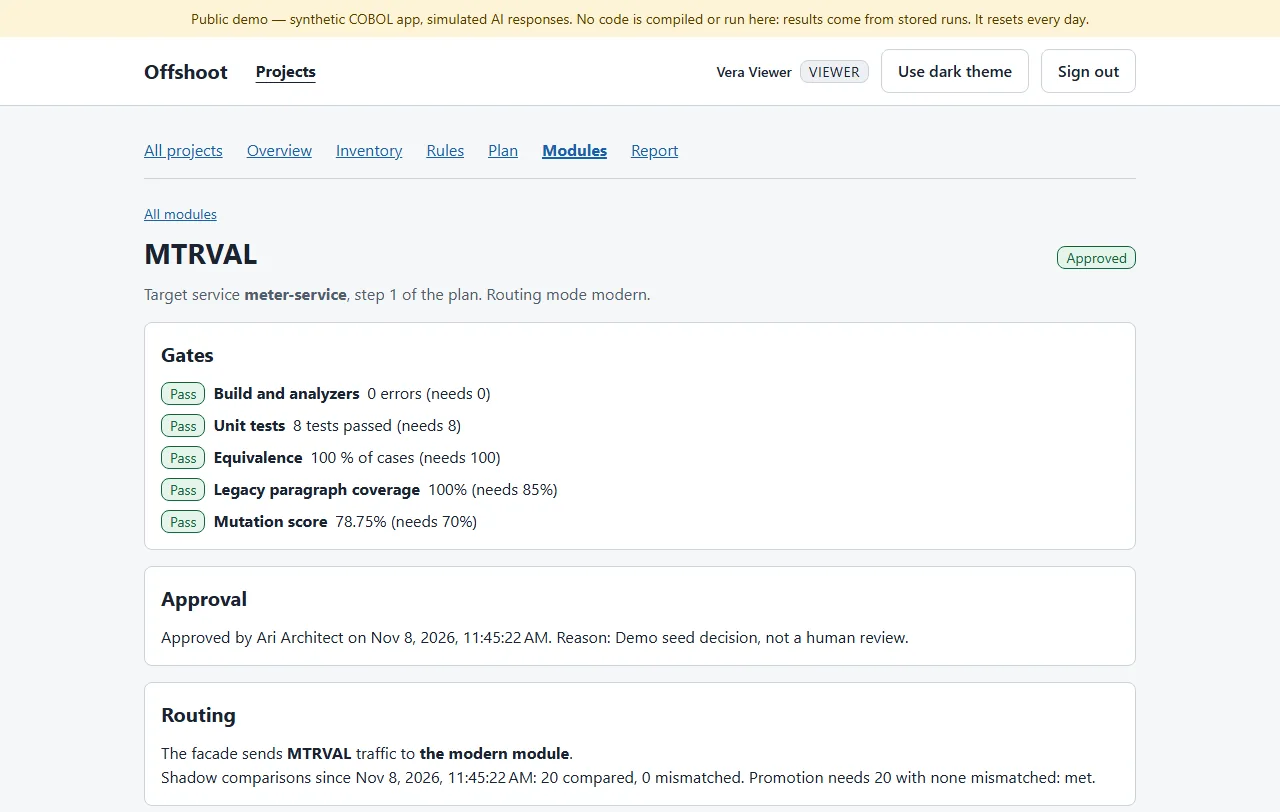
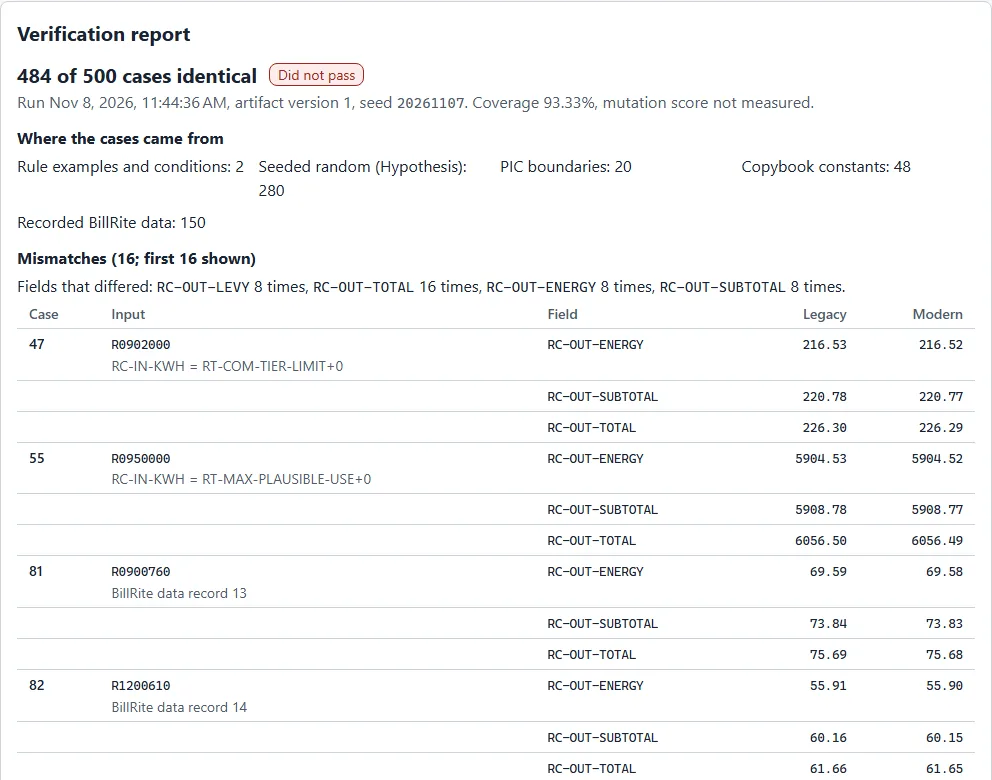
  • Rounding defect caught: the first C# rate calculator passed its own unit tests but matched only 484 of 500 cases. Each of the 16 mismatches was one cent, because C# rounded half a cent to the even cent (banker's rounding) where COBOL rounds half up. The module was blocked, and after one repair it matched 500 of 500.
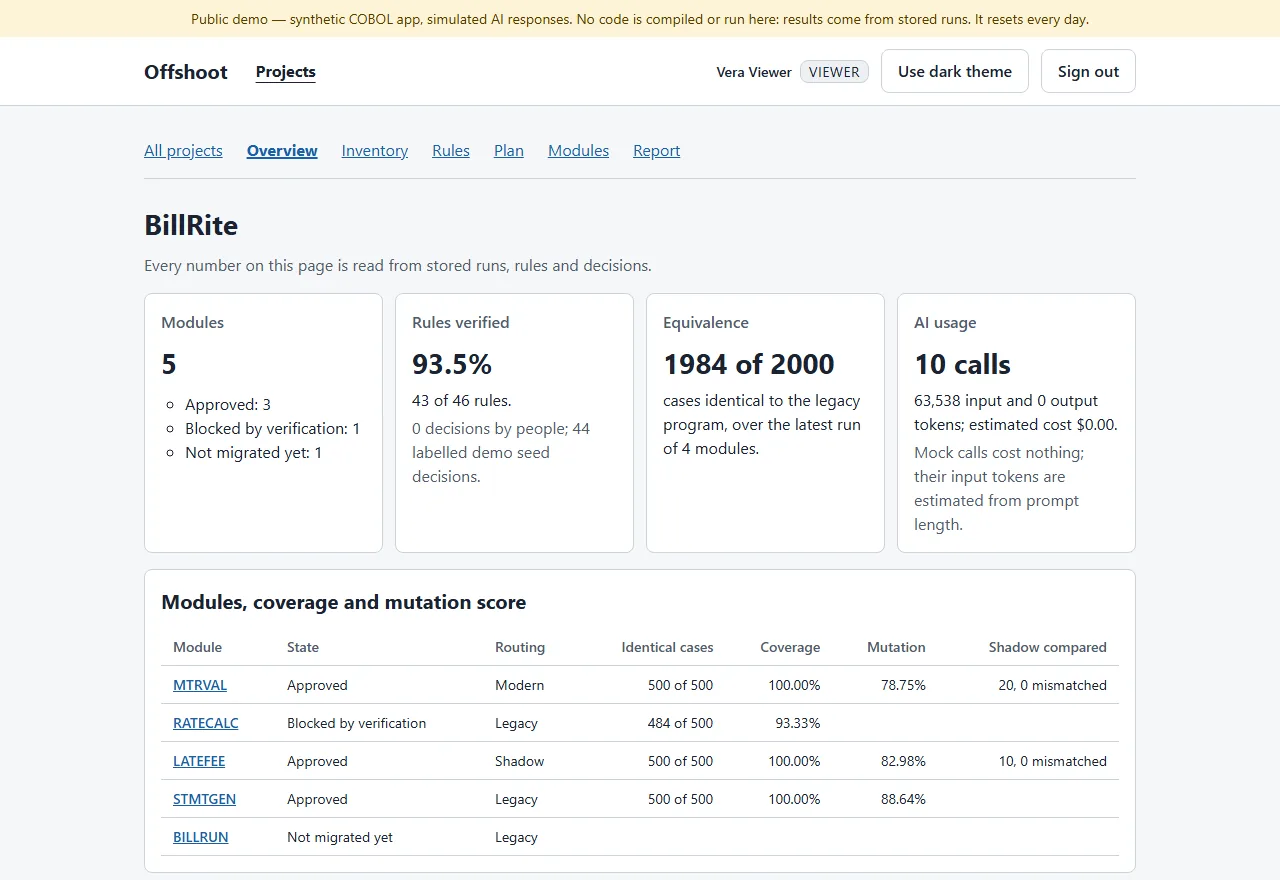
  • All 4 migrated modules verified at 500 of 500 equivalent cases, with mutation scores of 78.75%–88.64% and paragraph coverage of 93.33%–100%.
  • Shadow mode compared 20 requests with 0 mismatches before promotion to the C# module.
  • Rule extraction in the mock pipeline: 95.65% precision and 88.00% recall, with both planted hallucinations caught.
  • Live Gemini, small samples: rule extraction on 2 programs reached 93.33% precision, 63.64% recall, and 100% valid source spans. A live migration of one module (RATECALC) compiled on the first try and matched 500 of 500 cases with a 93.94% mutation score, with no repair needed.
  • The prompt-injection comment was never obeyed, and the model made 0 approvals. Production smoke tests on the live site: 14 of 14 passed.

All results come from a synthetic COBOL billing system. Real-world users and cost savings were not measured.

Screenshots

Offshoot verification report for the rate calculator: 484 of 500 cases identical, marked Did not pass, with one-cent differences between the legacy and modern values listed field by field.
The first C# rate calculator, blocked at 484 of 500 identical cases.
Offshoot module page for MTRVAL: all five gates pass (build, unit tests, 100% equivalence, 100% paragraph coverage, and a 78.75% mutation score), with architect approval and routing to the modern module after 20 shadow comparisons with 0 mismatches.
A verified module: every gate passed, then shadow mode and promotion.
Offshoot project overview for the synthetic billing system: module states, rules verified, equivalent cases across modules, and a table of identical cases, coverage, and mutation score for each module.
The project overview, read from stored runs.

Architecture flow

  1. A user works in the Angular UI.
  2. The FastAPI orchestrator runs each step as a job.
  3. Deterministic COBOL analysis builds the inventory, and the AI agent (Gemini or a mock) proposes rules, a plan, and C# code under strict contracts.
  4. Sandboxed runners build and run the code: GnuCOBOL for the legacy program, and a network-less .NET builder for the C#.
  5. The equivalence harness compares both on 500 seeded cases, and server-side gates decide what an architect can approve.
  6. PostgreSQL keeps every run and the append-only audit log, and the YARP strangler facade routes each module through legacy, shadow, and modern modes.

The model proposes, deterministic tooling verifies, and people approve.

Testing & quality

  • About 1,000 automated tests: 787 pytest, 163 Angular (Vitest), 26 .NET (xUnit), 18 Playwright and axe browser journeys in both themes, and a 14-test production smoke suite that also runs against the live site.
  • 136 characterization tests run the real COBOL against hand-computed expected values for each legacy quirk: half-up rounding, meter rollover, the two-digit-year window, truncation, and late-fee rules.
  • The same seed produces a byte-identical equivalence report, and a test checks it.
  • Sandbox attack tests: 9 of 9 hostile code samples fail the build, infinite loops hit the timeout, and a 4 GB allocation hits the memory limit.
  • Prompt-injection and hallucination fixtures, and a test that proves the answer key never reaches the AI.
  • GitHub Actions CI covers lint, strict types, dependency audits, a fresh-checkout Docker stack, a full-history secret scan, and a text-encoding check.

Real bugs found and fixed

  • A zombie-process leak in the .NET sandbox (454 processes against a limit of 512) that caused misleading build failures.
  • Login rate limits that silently never fired behind the hosting proxy.
  • A corrupted character in the live banner, traced to its root cause, with a new CI check to prevent it.
  • Gemini rejected the structured response schema, so 17 of 20 live calls failed. The schema moved into the prompt, with strict validation kept on the server.

Tech stack

Languages
  • Python 3.12
  • TypeScript
  • C#
  • COBOL
  • SQL
Backend
  • FastAPI
  • Pydantic v2
  • SQLAlchemy 2
  • Alembic
  • Hypothesis
Frontend
  • Angular 22
  • SCSS
Target
  • .NET 10
  • ASP.NET Core
  • YARP
  • xUnit
  • Stryker.NET
  • Roslyn analyzers
Legacy
  • GnuCOBOL 3.2
Database
  • PostgreSQL
  • Neon
AI
  • Gemini API (gemini-3.5-flash)
  • Mock agent
Infrastructure
  • Docker
  • Docker Compose
  • GitHub Actions
  • Render
Quality
  • pytest
  • ruff
  • mypy
  • Vitest
  • Playwright
  • axe
  • gitleaks

IknowServiceAI

An AI-assisted IT service desk where the AI drafts cited answers and people approve sensitive ones.

  • Python
  • FastAPI
  • React
  • PostgreSQL
  • Gemini API
My role
Solo project: wrote the product blueprint and requirements, designed the architecture, directed AI-assisted implementation, tested every user journey, and deployed it (Render + Neon).
Dates
Sep – Oct 2026
Status
Released (v1.0.0), with a live public demo

Try the demo

Sign in asRole
riley.morgan@demo.iknowservice.testRequester
sam.patel@demo.iknowservice.testRequester
alex.chen@demo.iknowservice.testSupport agent
jordan.reyes@demo.iknowservice.testAdmin

Password for every account: demo-only-public-2026

  • The public demo runs the built-in mock AI, so it shows the workflow and its safety gates. Live Gemini results come from the evaluation and the demo video.
  • All data is synthetic, shared, and reset daily.
  • It runs on free hosting, so the first load after idle can take up to about a minute.

Problem

Small organizations and campus IT help desks receive repetitive, free-text support requests, and staff spend time interpreting them, looking up documentation, and drafting answers. Generative AI could help, but uncontrolled AI can invent procedures, mishandle sensitive cases, or leak private data. IknowServiceAI uses AI to triage requests and draft answers from a trusted knowledge base, while code-enforced rules make sure a person reviews sensitive requests first.

Key features

  • AI triage of each request: category, priority, summary, and a suggested reply citing published knowledge-base articles, with every citation checked against what was actually retrieved.
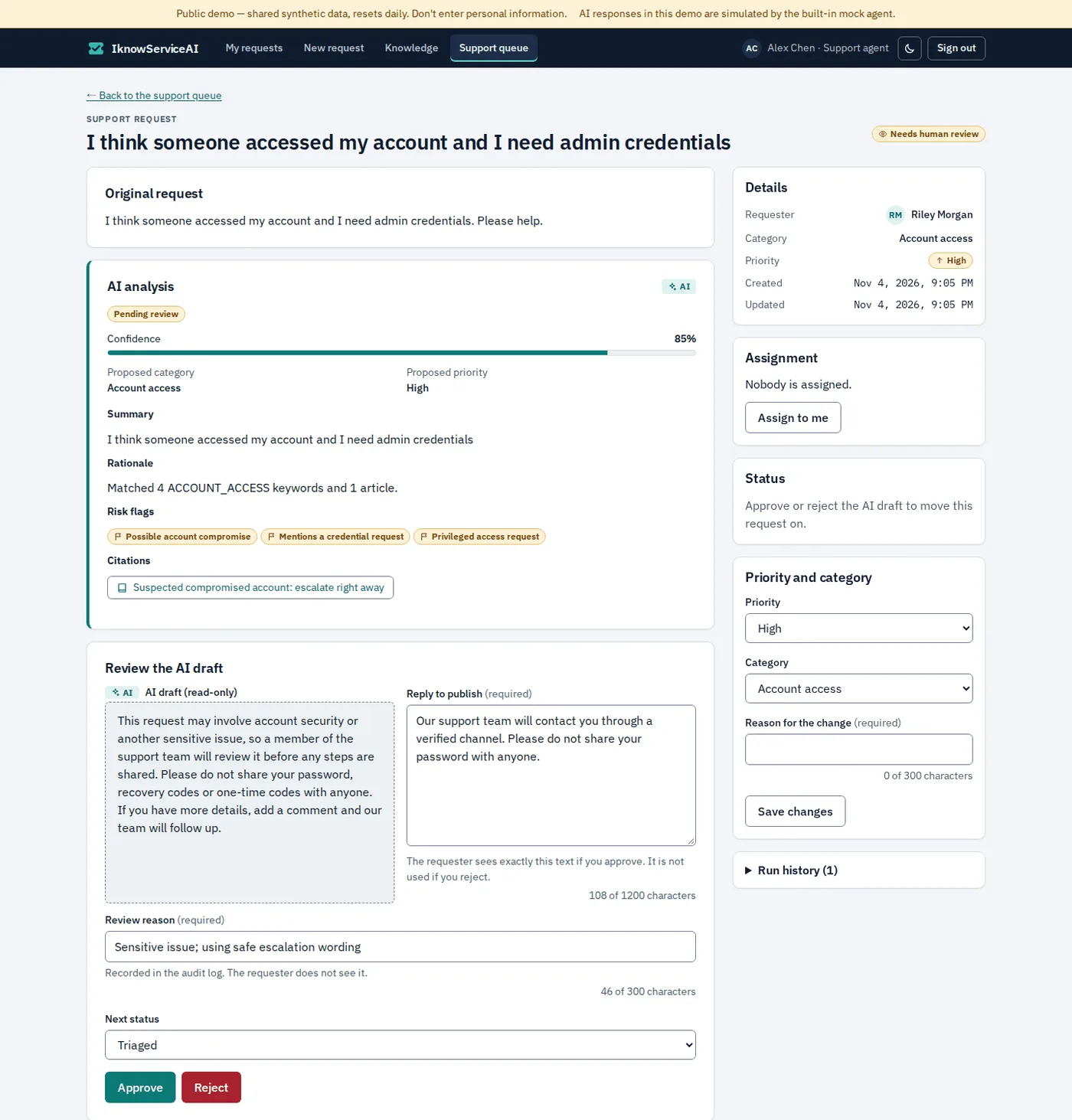
  • A deterministic policy gate holds sensitive requests, such as account compromise or credential requests, for staff review. The AI cannot override it, and requesters see nothing until a person approves a reply.
  • Staff review workspace to approve, edit, or reject AI drafts, with an unsafe-reply check: a reply that asks for a password, for example, is refused.
  • Role-based access for requesters, support staff, and admins, plus an append-only audit trail of every decision.
  • Knowledge-base management with PostgreSQL full-text search, plus privacy redaction and prompt-injection defences.
  • Public demo mode with shared demo accounts, a daily data reset, and light and dark themes.

Results

  • Held all 22 sensitive cases for review and produced zero invented citations on a 43-case evaluation set; a live Gemini sample also held 3 of 3.
  • Mock mode on the same 43 cases: 81.4% exact category accuracy.
  • Live Gemini, small 10-case sample: zero invented citations, with a median latency of about 16 seconds.

The first evaluation run held only 86.4% of sensitive cases. The patterns were then fixed, and the 100% figure is on the same set used to tune them, so it says little about new text.

Screenshots

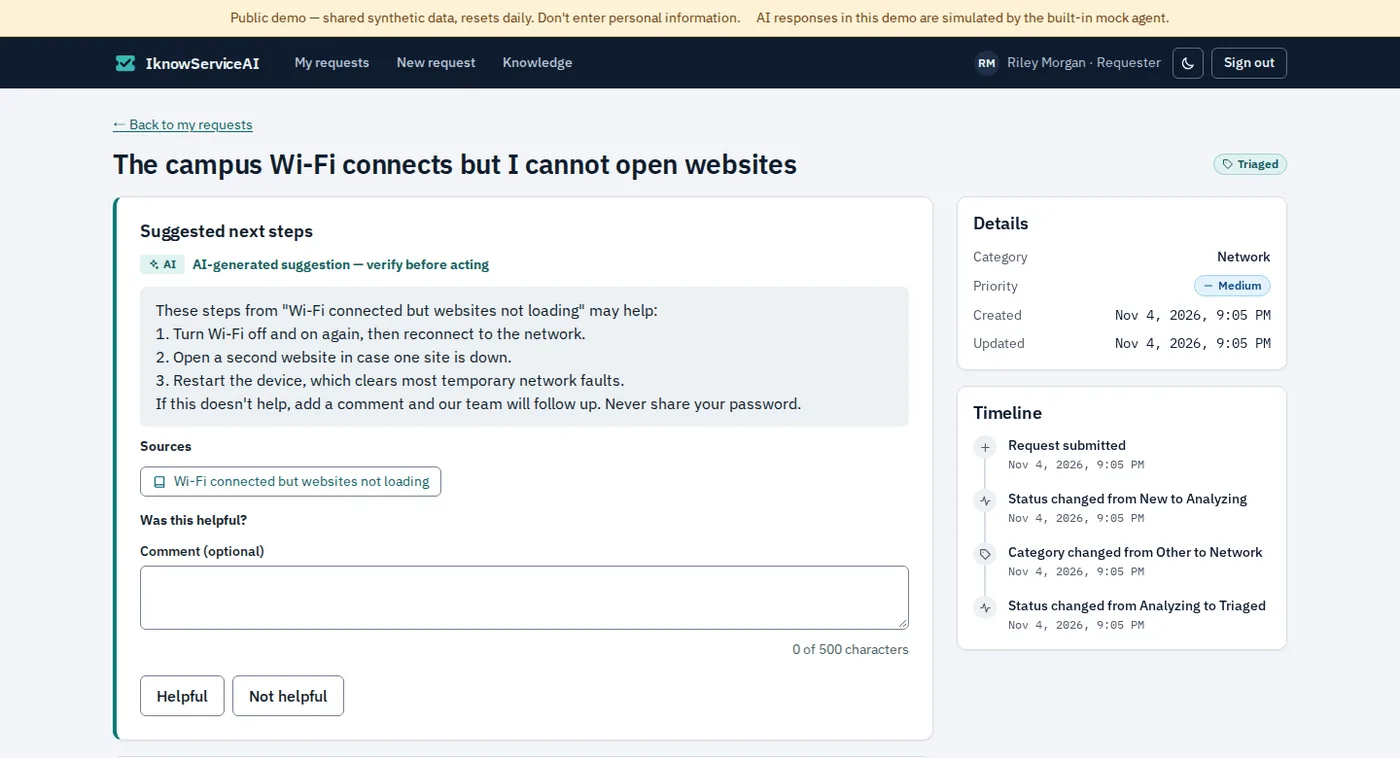
IknowServiceAI request page: an AI-generated suggestion, labelled to verify before acting, with numbered steps and a link to its knowledge-base source.
A requester sees a labelled AI suggestion with its source.
IknowServiceAI staff review workspace for a held request: AI analysis with a confidence score, risk flags, and a citation, the read-only AI draft beside the reply to publish, and Approve and Reject buttons.
Staff review a held, sensitive request before anything is published.
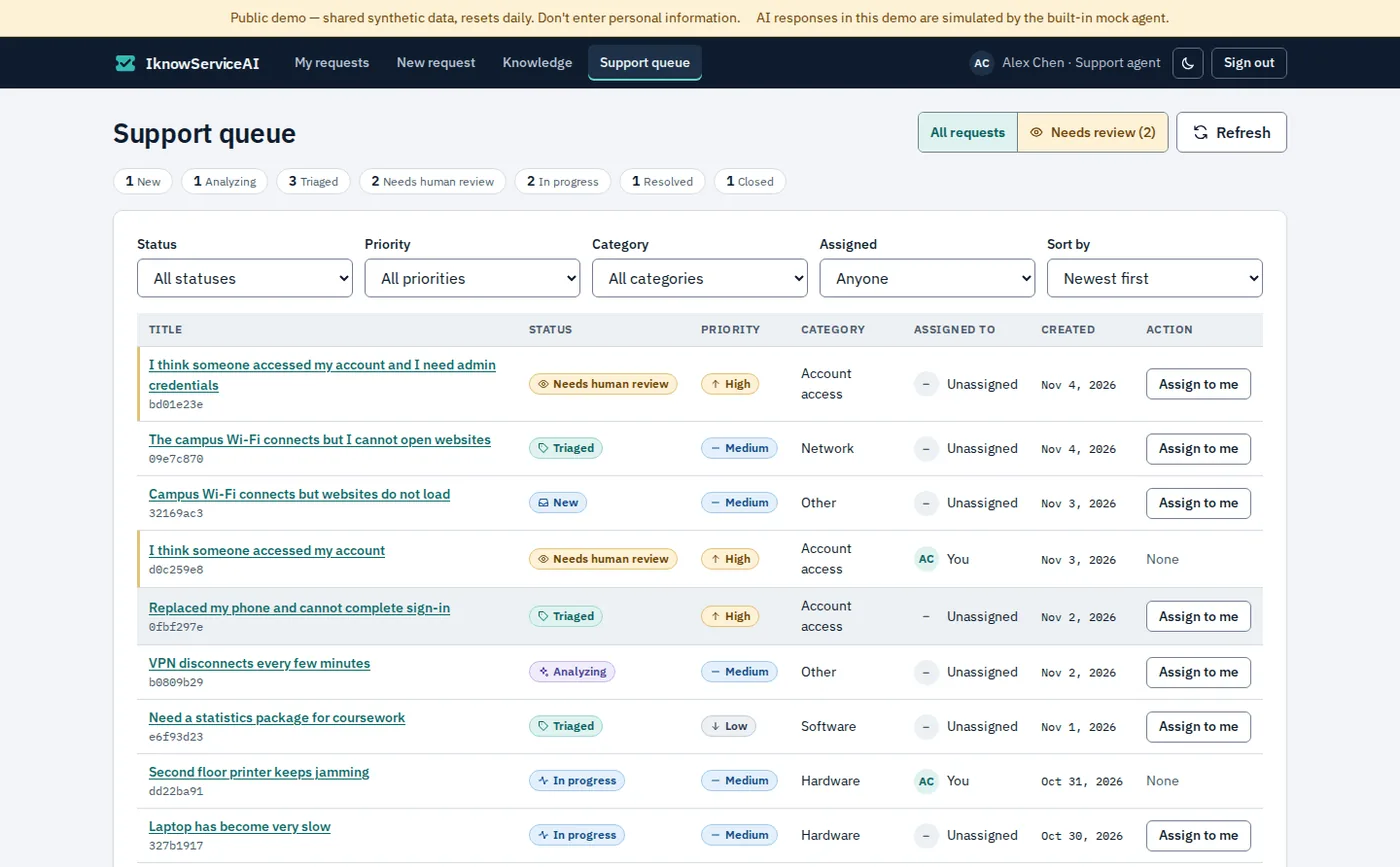
IknowServiceAI support queue listing requests with status, priority, category, and assignment, with held requests highlighted for human review.
The support queue, with held requests highlighted.

Architecture flow

  1. A user submits a request in the React UI.
  2. The FastAPI backend saves it, then redacts sensitive values such as emails, tokens, and keys.
  3. PostgreSQL full-text search retrieves published knowledge-base articles.
  4. The AI agent (Gemini or a built-in mock) proposes a category, priority, summary, and cited reply. Citations must match the retrieved, published articles.
  5. A deterministic policy gate holds any flagged request for staff, who approve, edit, or reject the draft.
  6. PostgreSQL (Neon) stores requests, replies, and the append-only audit trail.

The model only proposes text. It has no tools, and application code validates and writes everything.

Testing & quality

  • In CI: 876 backend and 242 frontend tests, plus end-to-end browser suites of 34 tests on the development stack and 46 on the production Docker image.
  • 172 axe accessibility checks with no findings, in light and dark themes, at desktop and 375 px mobile widths.
  • Security and adversarial tests: prompt injection, invented citation IDs, model attempts to skip review, cross-account access, duplicate or stale reviews, and rate limiting.
  • Mutation-style checks: safety controls were deliberately broken to confirm the tests catch it.
  • A 43-case evaluation set of ordinary, ambiguous, sensitive, and prompt-injection cases, plus a capped live Gemini sample.
  • Verified on the live deployment: security headers, secure cookies, session persistence after reload, rate limiting through the host's proxy (which found and fixed a real proxy-configuration bug), and data persistence after a redeploy.
  • Every user journey also tested by hand in the browser, locally and on the live site.

Tech stack

Languages
  • Python
  • JavaScript
Frontend
  • React
  • Vite
  • React Router
  • Plain CSS design system
Backend
  • FastAPI
  • Pydantic
  • SQLAlchemy 2
  • Alembic
  • psycopg
  • Argon2id
  • JWT with rotating HttpOnly refresh cookies
AI
  • Gemini API (gemini-3.5-flash-lite)
  • Mock agent
Database
  • PostgreSQL full-text search
  • Neon
Testing
  • pytest
  • Vitest
  • React Testing Library
  • Playwright
  • axe
DevOps
  • Docker
  • Docker Compose
  • GitHub Actions
  • gitleaks
  • Dependabot
  • Render

ClaimWillow

A home-contents insurance claims workflow with explainable rule checks, an audit trail, and automated testing.

  • Java
  • Spring Boot
  • React
  • TypeScript
  • PostgreSQL
My role
Solo project: designed the architecture and full specification, directed AI-assisted implementation, reviewed and tested the code, and deployed it to production (Render + Neon).
Dates
Oct – Nov 2026
Status
Released (v1.0.0), with a live public demo

Try the demo

UsernameRole
priyaPolicyholder
marcusPolicyholder
danaClaims adjuster
samClaims adjuster
adminAdministrator

Password for every account: demo1234

  • All data is synthetic, and the demo data may be reset at any time. It is not a real claims system.
  • It runs on free hosting, so the first load after idle can take up to about a minute.

Problem

Home-contents insurance claims for damaged or lost belongings need a clear path from submission to decision. Policyholders need to see where their claim stands, and adjusters need consistent, explainable checks with a full record of who did what. ClaimWillow models this workflow for a fictional insurer, using synthetic data, as a demonstration of enterprise workflow design and layered test automation.

Key features

  • Policyholder claim intake: save drafts, submit against an active policy, and keep a snapshot of the policy's coverage limit, deductible, and period taken at submission.
  • Six deterministic validation rules (R1–R6): required inputs, policy active on the incident date, estimate against the coverage limit, deductible, potential duplicates, and completeness. Each finding is stored and explained in plain language.
  • Adjuster queue and review lifecycle: assign, start review, request more information, policyholder response, approve or reject, and close. Illegal transitions are rejected.
  • Safe concurrent editing: optimistic locking returns HTTP 409 on conflicting updates.
  • An append-only audit timeline for every important action, plus private evidence uploads (PDF, PNG, or JPEG, with type and size checks and role-checked downloads).
  • Staff reporting with CSV export, and admin user management to enable or disable accounts.

Results

  • All 10 browser acceptance scenarios from the specification pass (96 steps), and CI is green on main.
  • Latest CI on main: 75 backend unit, 60 backend integration, and 30 frontend tests, all passing.
  • A concurrency test confirms that only 1 of 6 simultaneous assignments succeeds; the others get a clear conflict response.
  • Deployed and working at $0 hosting cost on Render and Neon.

Screenshots

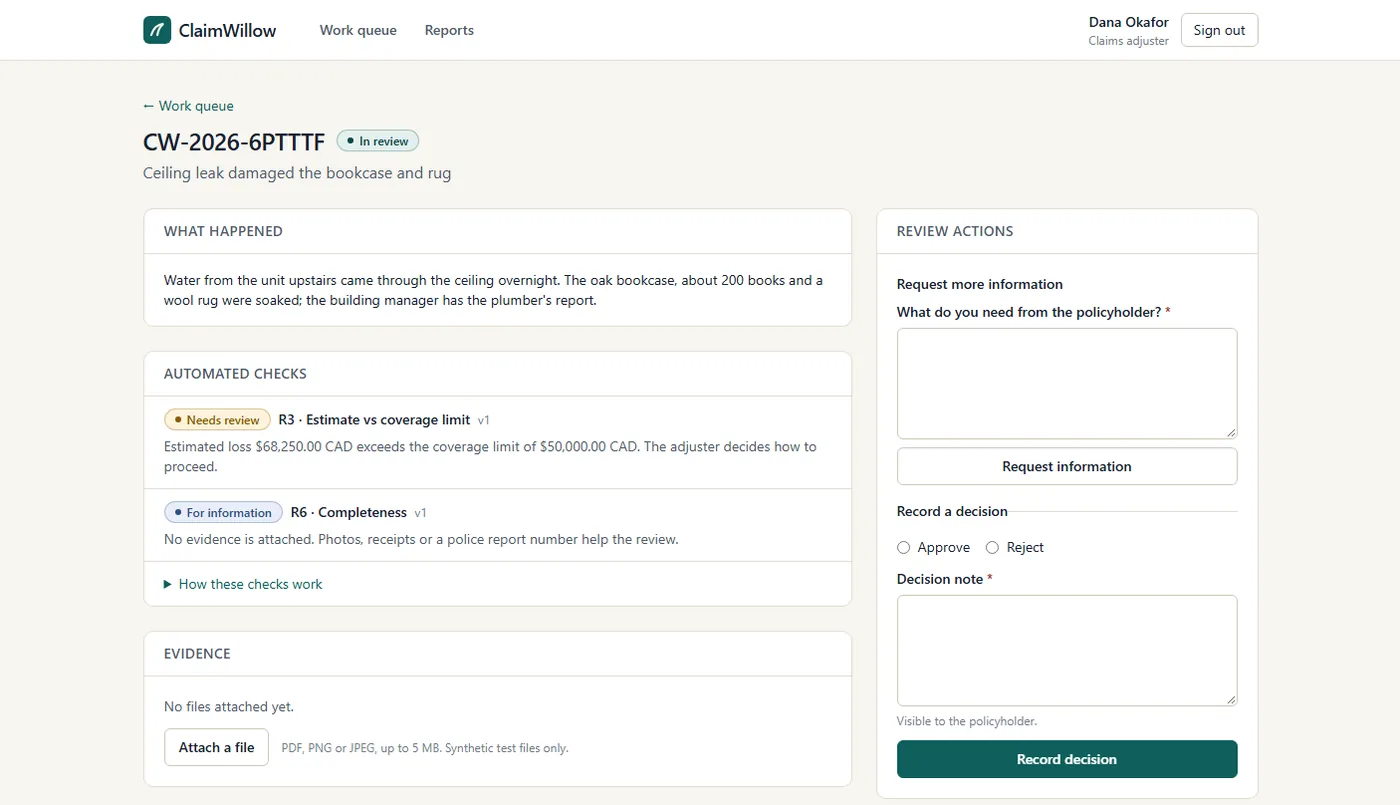
ClaimWillow adjuster view of a claim in review: automated checks R3 (estimate over the coverage limit) and R6 (completeness) explained in plain language, beside review actions to request information or record a decision.
An adjuster reviews a claim, with each rule finding explained.
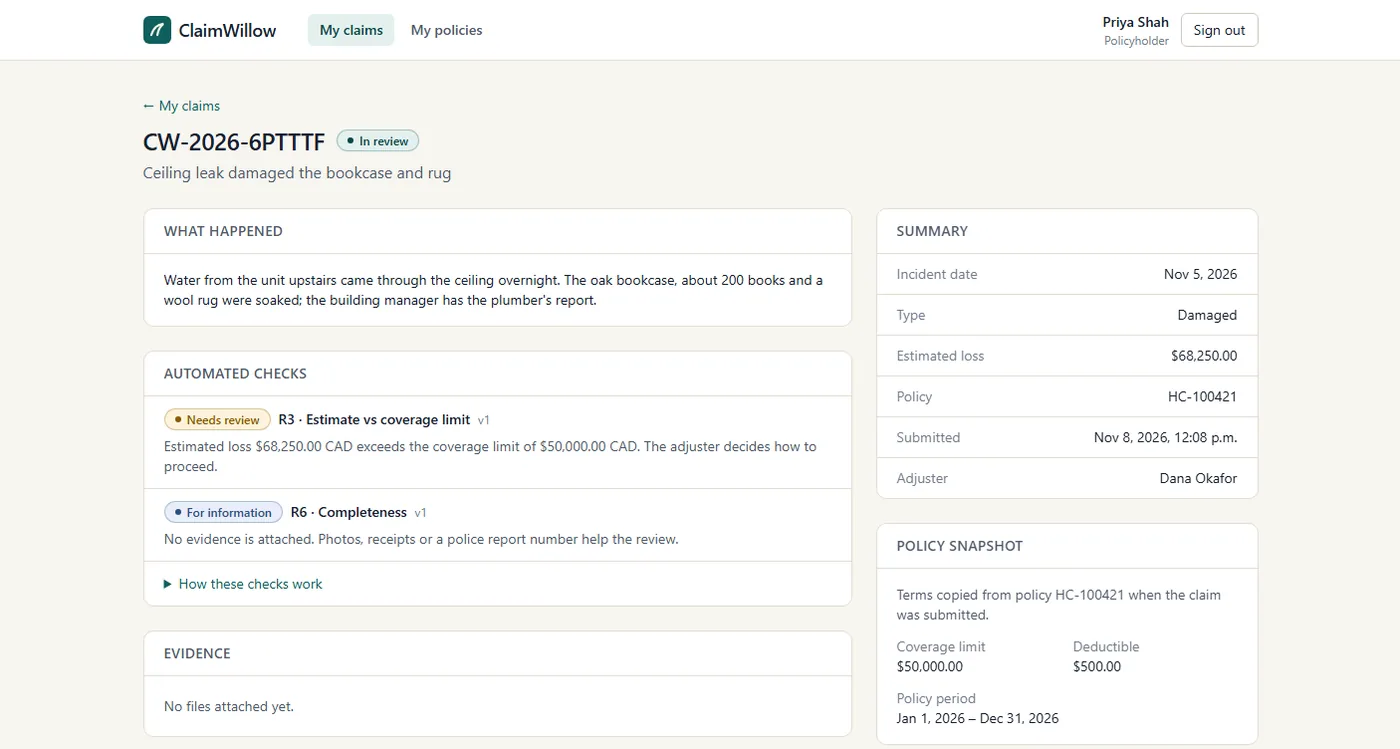
ClaimWillow policyholder view of a submitted claim: its status, automated checks, a summary of the incident and estimate, and the policy snapshot taken at submission.
The policyholder's view, with the policy snapshot taken at submission.
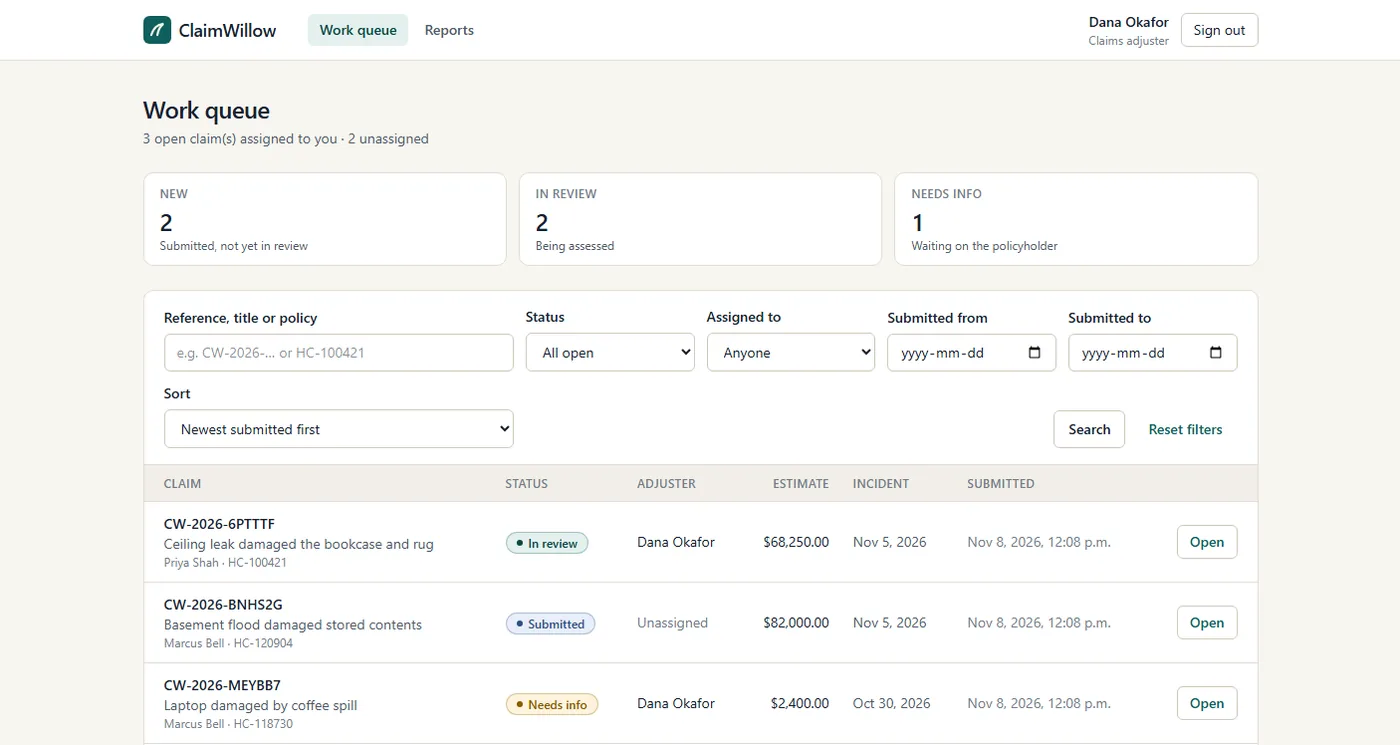
ClaimWillow adjuster work queue with counts of new, in-review, and needs-info claims, search filters, and a list of claims with status, adjuster, estimate, and dates.
The adjuster's work queue.

Architecture flow

  1. A policyholder, adjuster, or admin uses the React and TypeScript UI.
  2. The Spring Boot REST API authenticates with a server-side session and checks a CSRF token on every change.
  3. Claim services run the review state machine and rules R1–R6, and record audit events in the same transaction.
  4. JPA and Flyway map and migrate the data in PostgreSQL (Neon in production).

One Docker container on Render serves both the UI and the API.

Testing & quality

  • Backend unit tests (JUnit 5 and Mockito) for the rules, money calculations with BigDecimal, and state transitions.
  • Integration tests against a real PostgreSQL in Docker (Testcontainers): migrations, the claim lifecycle, 401/403/404 access boundaries, CSRF enforcement, a concurrent-assignment race, transaction rollback on a database failure, attachment authorization, and CSV export.
  • Frontend tests (Vitest and React Testing Library) for forms, validation messages, and role-specific actions.
  • 10 browser acceptance scenarios (Cucumber and Selenium in headless Chrome), with screenshots captured on failure.
  • GitHub Actions CI on every pull request, with a protected main branch that requires CI to pass. The production Docker image was smoke-tested under a 512 MB memory limit.
  • Checked by hand locally and on the live site: logins for each role, policies, claims, and a submitted claim showing its rule findings and history.

Tech stack

Languages
  • Java 21
  • TypeScript
Backend
  • Spring Boot 4.1.2
  • Spring Security (sessions, CSRF, BCrypt)
  • Spring Data JPA
  • Flyway
Frontend
  • React
  • Vite
  • Tailwind CSS
Database
  • PostgreSQL 16
  • Neon
Testing
  • JUnit 5
  • Mockito
  • Testcontainers
  • Vitest
  • React Testing Library
  • Selenium
  • Cucumber
DevOps
  • Docker
  • Docker Compose
  • GitHub Actions
  • Dependabot
  • Maven
  • npm
  • Render

Duck Duck Defer

Award-winning

An AI-integrated Android app that manages deferred university exams for students, faculty, and administrators.

  • Kotlin
  • Jetpack Compose
  • Firebase
  • Gemini API
My role
Frontend Software Developer / Business Analyst
Team
Five-member Agile/Scrum team

Problem

Deferred exams relied on manual scheduling and scattered information, which led to booking conflicts, limited room capacity, communication delays, and repetitive administrative work. The goal was one system for students, faculty, administrators, and proctoring.

System features, built by the team

  • Role-based dashboards with their own navigation, data, quick actions, and permissions.
  • Exam booking by date, room, and time slot, with seat tracking, conflict checks, and transactional seat updates.
  • Exam lifecycle: Booked, Fee Paid, Checked In, Exam Finished, Dropped Off, Faculty Received.
  • DuckBot, a Gemini-powered assistant that answers policy questions and helps with supported actions. The developer guide documents approximately 28 executable commands and 14 navigable screens.
  • Real-time messaging and notifications through Firestore listeners and Firebase Cloud Messaging.
  • QR check-in and proctoring, including assigned sessions and incident reporting.
  • Access control in the application design: Firebase Authentication, admin approval, server-side role checks, biometric login, and encrypted local credentials.
  • Gamification, accessibility settings, and a home-screen booking widget.

Architecture flow

MVVM data flow: Compose UI, ViewModel, Repository or Firebase services, Firestore or Cloud Functions, real-time state, updated UI.

DuckBot action pipeline:

  1. A user types a request in the chat.
  2. The ViewModel adds role and policy context.
  3. The request goes to the Gemini API.
  4. Structured action markers are parsed from the response.
  5. The action registry checks what the role supports.
  6. A wizard collects any missing inputs.
  7. The secure action service calls Cloud Functions with authentication.
  8. Server-side code validates permissions and performs the operation.
  9. The result returns to the conversation.

An AI-generated request is not treated as authorization: sensitive operations go through protected backend endpoints.

Testing

JUnit, AndroidX Test with Espresso, Compose UI Test, and ArchUnit. The team tracked and fixed defects iteratively across notification navigation, booking forms, account management, and availability.

My contributions

I contributed to requirements-oriented development, role-based UI and workflows, modular application components, frontend, backend, and database integration, AI and Firebase integration, testing, debugging, and documentation.

Tech

  • Kotlin
  • Jetpack Compose
  • Material Design 3
  • Node.js
  • Firebase Authentication
  • Cloud Firestore
  • Cloud Functions
  • Cloud Storage
  • Cloud Messaging
  • Gemini API
  • REST APIs
  • Android Studio
  • Gradle
  • Git/GitHub
  • JUnit
  • AndroidX Testing
  • ArchUnit

Movie Rental Database Management System

A C#/.NET Windows Forms application backed by a relational SQL database for rentals, inventory, and reporting.

  • C#
  • .NET
  • SQL
  • Windows Forms
My role
Database design, SQL queries, C#/.NET integration, and testing

Problem

A rental business needs customers, titles, availability, rental history, and transactions to stay connected and consistent. Fragmented records create duplication, inaccuracies, and difficulty reporting on activity.

Features

  • Customer and movie management with SQL CRUD operations and search.
  • Rental processing and transaction tracking, relating customers to rented movies and rental history.
  • Relational schema designed from an ER model, with primary keys, foreign keys, and referential integrity.
  • Advanced queries using joins, nested queries, aggregates, and GROUP BY.
  • Business reporting on sales-related information, rental activity, popular movies, and customer behavior.
  • Employee and customer user types, each with its own available operations.

Architecture flow

A conceptual view of three logical layers:

  1. Presentation: Windows Forms screens, user input, and navigation.
  2. Application logic: C# operations that connect user actions to the database and enforce workflow logic.
  3. Data storage: the SQL schema, keys, constraints, queries, and persisted customer, movie, and rental information.

Testing

Software testing, debugging, and defect resolution focused on application logic, query accuracy, transactions, integration between the C# forms and SQL, and database consistency.

My contributions

My work covered designing database schemas and ER diagrams, implementing SQL CRUD and reporting queries, building the Windows Forms connection to the database, supporting rental and inventory functions, and testing and debugging the application.

Tech

  • C#
  • .NET
  • Windows Forms
  • SQL
  • Relational Database Design
  • ER Modeling
  • Visual Studio

Tower of Finance

A Unity tower-defense game that combines gameplay with financial-literacy quizzes and progression.

  • C#
  • Unity
My role
Gameplay systems, program logic, and interface components

Problem

Combining financial-literacy learning with tower-defense gameplay, so that quizzes and finance mechanics are part of how the game progresses.

Features

  • Player systems: movement, shooting, and projectiles.
  • Enemies: enemy AI, health, and wave spawning.
  • Finance mechanics: finance points, upgrades, quizzes, and progression.
  • Game flow: gameplay state transitions and victory and game-over logic.
  • Interfaces for gameplay metrics, quiz screens, mission displays, upgrades, and wave results.

Gameplay loop

A conceptual view of how the documented systems fit together:

  1. A wave of enemies spawns.
  2. The player moves and shoots while enemy AI and health play out.
  3. Finance points, quizzes, and upgrades drive progression.
  4. Wave results lead to the next wave, or to victory or game over.

Testing

Iterative testing and debugging of runtime behavior, script interactions, component references, and UI issues.

My contributions

I designed algorithms and program logic for game behavior, progression rules, user interactions, and financial-literacy features, and built interactive UI components.

Tech

  • C#
  • Unity

Visit my GitHub ↗

Skills

Programming Languages

8 skills
  • Python
  • JavaScript
  • TypeScript
  • Java
  • C#
  • Kotlin
  • SQL
  • COBOL

Software Development

16 skills
  • .NET
  • ASP.NET
  • ASP.NET Core
  • Node.js
  • React
  • Angular
  • FastAPI
  • Spring Boot
  • Jetpack Compose
  • Windows Forms
  • Object-Oriented Programming (OOP)
  • Full-Stack Development
  • Frontend Development
  • Backend Development
  • Android Development
  • Microservices

Artificial Intelligence & Machine Learning

12 skills
  • Generative AI
  • Gemini API
  • Natural Language Processing (NLP)
  • scikit-learn
  • K-Means Clustering
  • TF-IDF
  • Regression Analysis
  • AI Agents
  • AI Integration
  • AI Governance
  • Responsible AI
  • Human-in-the-Loop Systems

Databases

13 skills
  • PostgreSQL
  • SQL
  • SQLAlchemy
  • Firebase
  • Cloud Firestore
  • Relational Database Design
  • Database Management
  • ER Diagrams
  • CRUD Operations
  • Data Modeling
  • Database Queries
  • Data Integrity
  • Referential Integrity

Cloud & Backend Technologies

10 skills
  • Firebase Authentication
  • Firebase Cloud Functions
  • Firebase Cloud Messaging
  • Firebase Cloud Storage
  • REST APIs
  • API Integration
  • Docker
  • Backend Services
  • Render
  • Neon

Development Tools

17 skills
  • Git
  • GitHub
  • GitHub Actions
  • Visual Studio
  • Android Studio
  • Gradle
  • Maven
  • JUnit
  • AndroidX Testing
  • ArchUnit
  • pytest
  • Vitest
  • Playwright
  • Selenium
  • Cucumber
  • Testcontainers
  • Unity

Software Engineering

14 skills
  • Software Development Life Cycle (SDLC)
  • Agile
  • Scrum
  • Software Architecture
  • System Design
  • Requirements Analysis
  • Software Testing
  • Unit Testing
  • Integration Testing
  • Debugging
  • Troubleshooting
  • Defect Resolution
  • Code Review
  • Version Control

Data Analytics

17 skills
  • Pandas
  • NumPy
  • Microsoft Excel
  • Power BI
  • Tableau
  • Matplotlib
  • Plotly
  • OpenPyXL
  • Data Analysis
  • Data Cleaning
  • Data Transformation
  • Data Validation
  • Data Visualization
  • Statistical Analysis
  • Dashboard Development
  • Reporting
  • Data Quality Management

Automation

11 skills
  • Python Automation
  • Workflow Automation
  • Process Automation
  • API Automation
  • Data Processing Pipelines
  • Document Automation
  • Data Extraction
  • PDF Processing
  • PyMuPDF
  • pdfplumber
  • python-docx

Cybersecurity & Privacy

8 skills
  • Authentication
  • Authorization
  • Role-Based Access Control
  • Data Privacy
  • Secure Credential Handling
  • Privacy-Aware Design
  • Security Awareness
  • Data Protection

UI/UX Design

9 skills
  • Figma
  • User Interface Design
  • User Experience Design
  • Wireframing
  • Prototyping
  • Human-Computer Interaction
  • Usability Testing
  • User-Centered Design
  • Accessibility

Research & Statistics

11 skills
  • Quantitative Research
  • Qualitative Research
  • Literature Reviews
  • Survey Analysis
  • Regression
  • Reliability Analysis
  • Data Collection
  • Research Methodology
  • Statistical Modeling
  • Research Documentation
  • Evidence Synthesis

Business Analysis

12 skills
  • Business Systems Analysis
  • Business Requirements Gathering
  • Functional Requirements
  • Process Mapping
  • Workflow Analysis
  • Use Cases
  • Business Process Improvement
  • Stakeholder Analysis
  • Gap Analysis
  • System Analysis
  • Reporting
  • Decision Support

Project Management

9 skills
  • Agile Project Coordination
  • Task Prioritization
  • Scheduling
  • Project Planning
  • Resource Coordination
  • Risk Identification
  • Stakeholder Management
  • Cross-Functional Collaboration
  • Event Coordination

Documentation

8 skills
  • Technical Documentation
  • Process Documentation
  • Software Documentation
  • UML Diagrams
  • Research Reports
  • Standard Operating Procedures
  • User Guides
  • Presentation Development

Learning & Development

9 skills
  • Training Coordination
  • Learning Needs Analysis
  • Learning Content Development
  • Training Documentation
  • Knowledge Sharing
  • Learning Evaluation
  • Employee Development
  • Learning Analytics
  • Continuous Improvement

Microsoft & Productivity Tools

5 skills
  • Microsoft Excel
  • Microsoft Word
  • Microsoft PowerPoint
  • Microsoft 365
  • Google Workspace

Professional Skills

18 skills
  • Problem-Solving
  • Critical Thinking
  • Analytical Thinking
  • Communication
  • Teamwork
  • Leadership
  • Adaptability
  • Time Management
  • Attention to Detail
  • Organizational Skills
  • Collaboration
  • Presentation Skills
  • Stakeholder Communication
  • Independent Learning
  • Continuous Learning
  • Research Skills
  • Decision-Making
  • Innovation

Organizations

Vice President

MacEwan AI Alliance (MAIA), MacEwan University

Sep 2026 – Present

I work with the club's executive leadership to support student initiatives in artificial intelligence, machine learning, and emerging technologies.

  • Work with other executives on the direction and priorities of student-led AI initiatives.
  • Contribute to planning and coordinating community activities focused on learning about and exploring AI.
  • Promote student engagement, accessible technical learning, and knowledge sharing in an inclusive AI-focused community.
More details
  • Support cross-functional cooperation and communication among club leadership and participants.
  • Help align proposed initiatives with the group's educational mission.

Director of Events

MacEwan Data Analytics Club, MacEwan University

Oct 2025 – Present

I help coordinate club activities that support learning, collaboration, and student engagement in data and analytics.

  • Coordinate planning and logistics for club events, supporting speaker sessions, technical workshops, and project activities.
  • Work with executives, students, and external participants on schedules, technical setup, materials, and resources.
  • Handle event-delivery challenges and shifting priorities, using Agile-inspired coordination where helpful.
More details
  • Support clear communication before and during activities.
  • Contribute to collaborative planning, knowledge sharing, and continuous improvement within the club.

Student Volunteer

MacEwan International Badminton Club

Jan 2026 – Present

I help support recreational student activities and contribute to a welcoming campus community.

  • Help prepare spaces and equipment for recurring club activities.
  • Support weekly operations, event logistics, and coordination among club participants.
  • Work with volunteers and organizers to keep events running smoothly and adapt to small operational problems.
More details
  • Support participation and student engagement.
  • Help maintain an organized and inclusive experience for members.

Education

Bachelor of Science in Computer Science

MacEwan University · Edmonton, Alberta · Sep 2023 – Dec 2027

Expected Dec 2027

Minors in Cybersecurity and Marketing.

Coursework
Software Engineering, File & Database Management, Data Structures & Algorithms, Practical Programming Methodology, Human–Computer Interaction

Contact

Let’s build something useful.

I am open to internships, co-ops, and new grad roles in AI and software development.